
A kitchen comparison becomes difficult to interpret when everything changes at once. One soup arrives hotter, another contains more salt, and the third is introduced as the chef’s favourite. A clear preference may emerge, but it will be unclear what caused it. A small blind tasting is most useful when the question is narrow enough for the preparation to answer.
You do not need to turn an ordinary meal into a laboratory session. The aim is to make a manageable comparison, record what actually happened and avoid asking the results to carry more meaning than the exercise supports.
Write one question before preparing the samples
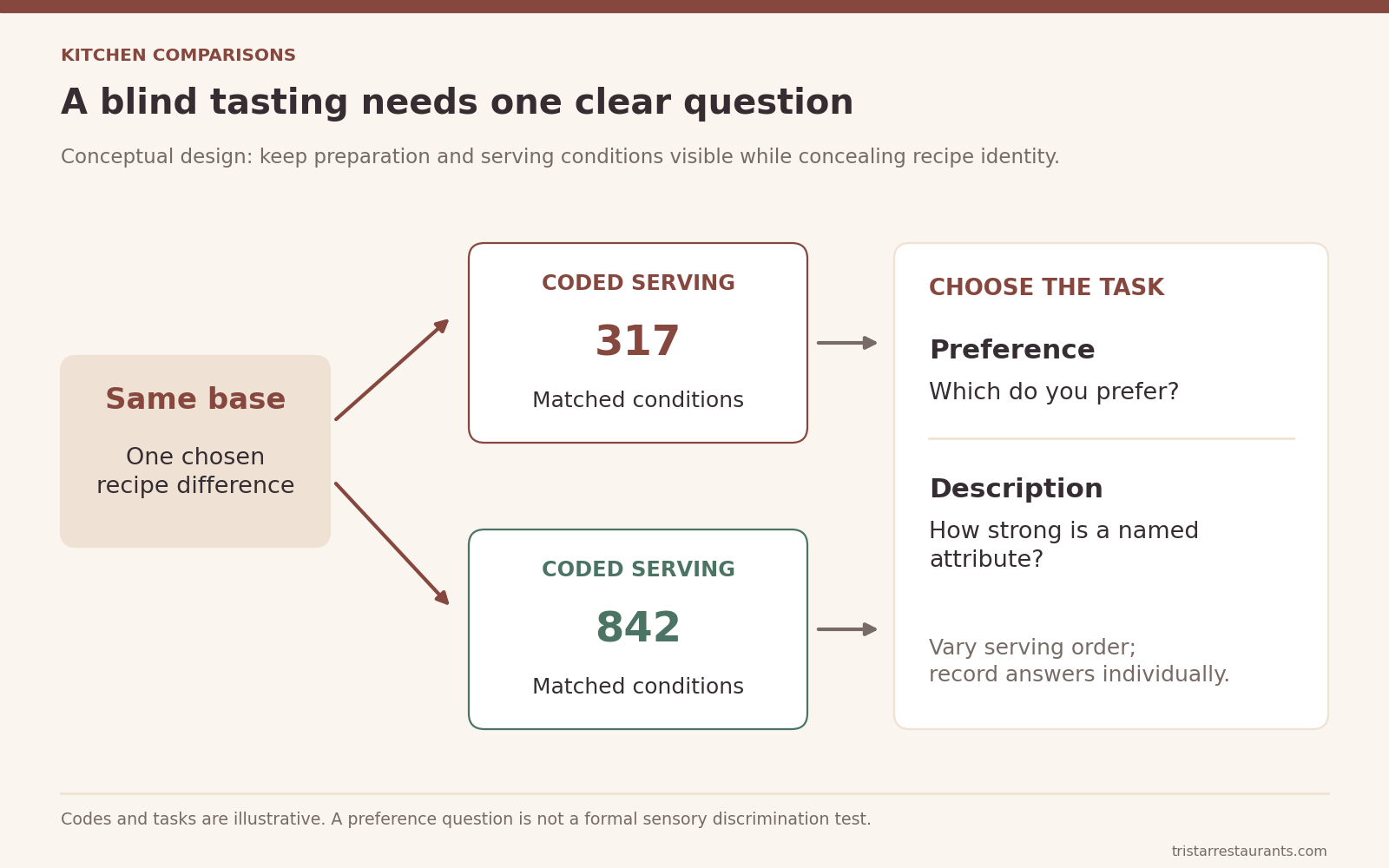
Choose a question such as “Which of these two finished soups has the stronger roasted aroma?” That is different from “Which soup do you prefer?” and different again from “Can you distinguish them?” A taster could notice a difference, prefer the milder version and still describe the stronger aroma accurately.
For an illustrative comparison, divide one prepared base into two portions and change a single ordinary ingredient feature. Keep the remainder of the recipe consistent. This is a practical application of the distinction between an experimental factor and a measured response described in the NIST guidance on completely randomized designs.
Give each sample an uninformative code
Labels such as “premium,” “traditional” and “improved” communicate expectations before anybody tastes. Use neutral three-digit codes instead. Keep a separate key connecting each code with its recipe. The person handing out the cups can also be kept unaware of that key if the exercise needs stronger protection against hints.
A code does not make every influence disappear. Colour, garnish or a recognizable ingredient may reveal which sample is which. Record such clues instead of pretending the comparison was perfectly concealed. A useful record can say that recipe names were hidden while appearance remained visible.
Make the serving conditions comparable
Use similar containers, portion sizes and serving temperatures. Put the samples through the same holding period as far as practical. A sauce that sits uncovered may develop a skin or concentrate through evaporation, creating a second difference unrelated to the intended change.
Write down preparation and serving times. The point is not to invent elaborate precision; it is to notice ordinary sources of variation. If one batch was prepared much earlier, keep that information beside the ratings. It may explain why a repeat tasting produces a different result.
Vary the order without changing the question
If everybody receives sample A first, the first-position experience becomes tangled with the recipe. For a small two-sample exercise, let some people receive A then B and others B then A. Keep the wording of the question the same for both orders.
The second sample may be affected by what came before it. Strong flavours can linger, and a person may become accustomed to a sensation during the session. Provide a pause and a neutral palate reset appropriate to the foods. Avoid adding many products simply because the table has space for them.
| Keep consistent | Record separately |
|---|---|
| Base recipe and portion size | The intended ingredient change |
| Serving container and temperature | Sample order and neutral code |
| Question and response scale | Individual rating and brief comment |
Distinguish a preference task from a difference task
A preference task asks which option a person likes more. A descriptive task asks about an attribute, such as saltiness or roasted aroma. A difference task asks whether products can be distinguished. These are related activities, but success on one does not supply the answer to another.
The formal triangle method presents three coded samples, two from one product and one from the other. The ISO 4120 description of triangle testing explains that it addresses sensory difference or similarity, not the size, direction or cause of a difference. Calling an informal tasting a standardized test would require meeting the full method, not merely placing three cups on a tray.
Collect individual answers before discussion
A lively group discussion is excellent for menu ideas but can blur an individual assessment. Ask tasters to record their answers first. A confident speaker’s description may otherwise become the phrase everybody repeats, even when their initial impressions differed.
Use a short form with the sample code, the chosen attribute, a clearly labelled scale and one optional comment. Do not combine several sensations into an unexplained “quality” score. Someone writing “more intense” should identify whether they mean aroma, saltiness, heat from chilli, thickness or another feature.
Work through a small fictional result
Imagine eight tasters compare two soups. Five prefer A and three prefer B. Four describe A as having a stronger roasted aroma, two describe B that way and two report no clear difference. These invented results show why preference and attribute ratings should stay in separate columns.
It would be inaccurate to announce that A is objectively better or that roasting explains everyone’s preference. The group is small, the observations may be variable, and several people can like different qualities. The result may still support a practical next step: repeat the comparison with the same question before changing the whole menu.
Separate repeat servings from repeat preparation
Three spoonfuls from one saucepan are three servings of the same preparation. They do not show how consistently the recipe performs across three independently cooked batches. This distinction matters when a small tasting is used to make a kitchen decision.
If the question concerns repeatability, record the preparation batch as well as the sample code. A later tasting can compare newly prepared versions under similar serving conditions. If the result changes, investigate the preparation record before assuming that the tasters were wrong. The first session may have captured a real difference between those particular batches while leaving the broader recipe question unresolved.
Keep the conclusion close to the exercise
A suitable conclusion names the products, the people who tasted them, the serving conditions and the question. For example: “In this staff tasting, more participants preferred the revised soup, while aroma ratings were mixed.” That sentence is narrower than a marketing claim, but it is much more useful for deciding what to examine next.
Keep the recipe key and raw responses with the summary. If a later trial reverses the outcome, compare preparation, temperature and sample order before assuming that the tasters were inconsistent. Careful tasting creates a record of a particular food experience. That habit becomes valuable when reading research about flavour molecules and peptides, where the food surrounding a compound can change the sensory question.